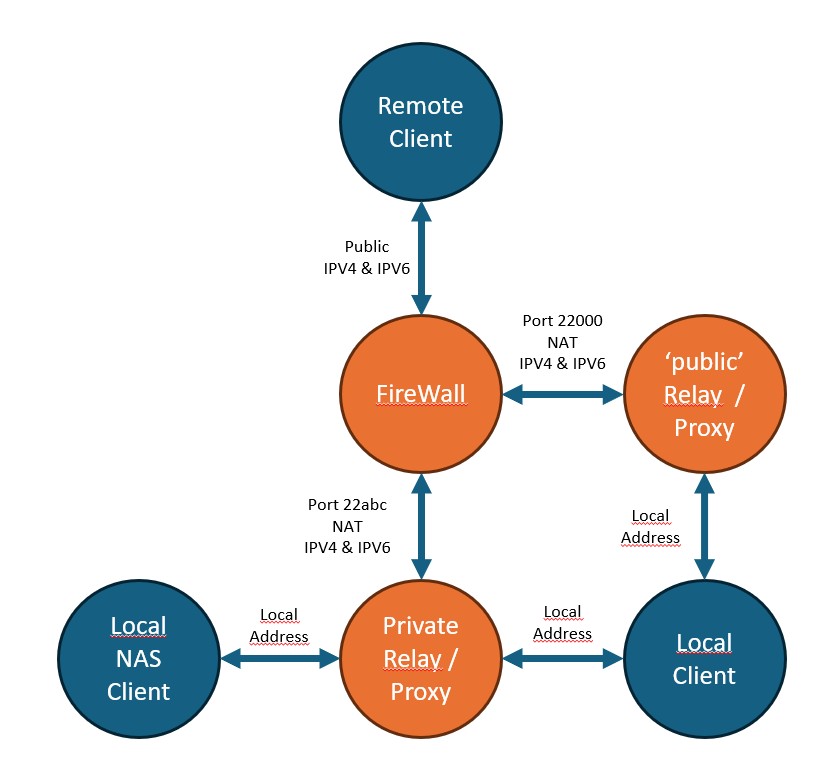
I try to setup an private relay which should listen to both IPV4 and IPV6. I do not manage, I can either define the relay to listen to IPV4 OR to IPV6 not both !!
I tried a lot …
The config file for relays turned out to be “/etc/default/syncthing-relaysrv”
(which is not documented eny where !!?)
The structure of the file is
"Default settings for syncthing-relaysrv (strelaysrv).
$ default NAT=true => false
NAT=false
$ Add Options here:
RELAYSRV_OPTS=
I did try many options the result is about this
$ OK IPV4 RELAYSRV_OPTS=-pools=“” -listen=“192.168.c.d:‘myPortNo’” -token=“‘mySecretToken’”
$ OK IPV4 RELAYSRV_OPTS=-pools=“” -listen=“:‘portno’” -token=“‘mySecretToken’”
(does not listen to IPV6)
$ OK IPV6 RELAYSRV_OPTS=-pools=“” -listen=“[a:b:c:d::e]:'myPortNo; " -token=”‘mySecretToken’"
Every thing I tried (many things) to create a listen string for both IPV4 and IPV6 failed
(example: -listen=“192.168.c.d:‘myPortNo’,[a:b:c:d::e]:‘myPortNo’”)
Mostly the error message was “too many colons in address”
Does any one know/can explain how to setup a relay which is working for both IPV4 and IPV6 !!??
PS: I had to replace “#” sign at some places above, since that sign ‘destroyed’ the layout of this message
The relay server listens on both IPv4 and IPv6 by default. You can uses it in this way by adding it specifically by address on both sides.
It can only register to a pool with either IPv4 or IPv6, not both, because the address the pool server sees needs to match the relay server’s announced address. Our public relay pool only accepts IPv4 relays.
If you are thinking a relay server would be a neat way to bridge between IPv4-only and IPv6-only Syncthing clients then, no, it’s not, in it’s current incarnation.
Remote client can be a a really trusted client
knowing port22abc and private relay secret
An other client using the default port 22000 routed to my ‘public’ relay
Both relays should not be part of any pool (-pool=“”)
The Relays (= Proxy’s) are virtual machines. It would be nice if one VM can full fill all the relay function’s:
private relay IPV4
private relay IPV6
‘public’ relay IPV4 (future)
‘public’ relay IPV6 (future)
My primary goal at this moment to set up the private part of this concept. Not sure if I will add the ‘public’ part / ‘public’-relay later. I have no direct use for that and I am not sure if I want to add that functionality from security perspective.